Why Your First Night Off After a Shift Stretch Feels Worse, Not Better
Quick Answer: The first night off after a night shift stretch often feels worse because your circadian rhythm hasn’t caught up yet — your body is still partially adapted to being awake at night, so trying to sleep at a normal nighttime hour on the first off-night frequently backfires into restlessness rather than deep recovery sleep.
The shifts are over, but your internal clock doesn’t know that yet — and the first off-night is usually when that mismatch is at its worst.

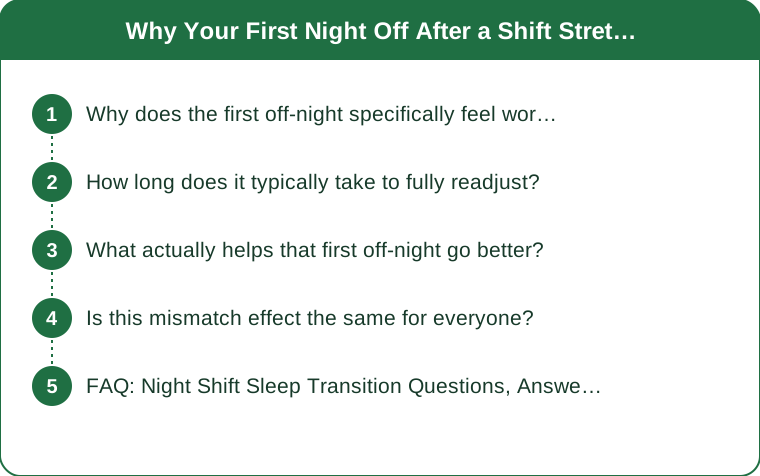
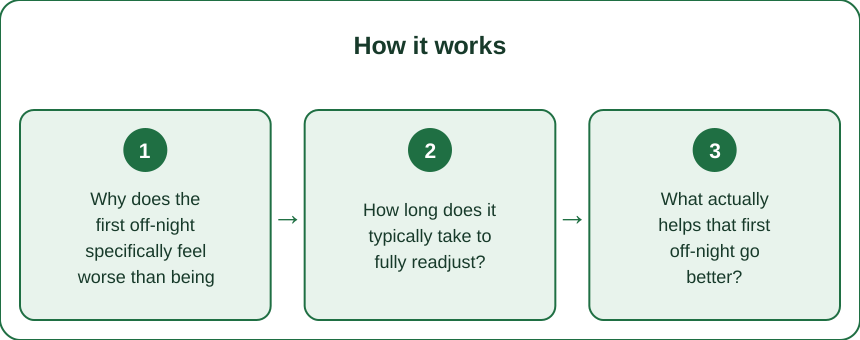
Why does the first off-night specifically feel worse than being mid-shift-stretch?
During a run of night shifts, the body partially adapts its circadian rhythm to being active at night — this adaptation doesn’t reverse the moment shifts end, so attempting to sleep at a typical nighttime hour on the very first off-night runs directly against a still-adjusted internal clock.
This is a well-documented circadian mismatch effect, distinct from ordinary tiredness, which is why simply being exhausted doesn’t guarantee good sleep that first night.
How long does it typically take to fully readjust?
Full circadian readjustment after a run of night shifts commonly takes several days, though the exact timeline varies by individual and how many consecutive night shifts were worked.
The first 24-48 hours off are often the most mismatched period, which is specifically why the very first off-night tends to feel the roughest rather than the most restorative.

What actually helps that first off-night go better?
Keeping a partial, gradual shift in sleep timing rather than jumping straight to a normal nighttime schedule — for example, sleeping a modified schedule for the first day or two — tends to ease the transition more than an abrupt switch.
Managing light exposure carefully (bright light in the evening if staying up a bit, avoiding bright light close to the target sleep window) supports the gradual circadian shift rather than fighting it.
Is this mismatch effect the same for everyone?
Individual chronotype and how many consecutive night shifts were worked both affect how pronounced this first-off-night mismatch feels — someone who’s naturally more of a night owl, or who worked a shorter shift stretch, may adjust somewhat faster than others.
Rotating shift workers tend to experience this mismatch more frequently and, for some, more intensely than workers on a fixed night schedule, simply due to more frequent transitions.
FAQ: Night Shift Sleep Transition Questions, Answered
Is it better to stay up through my usual daytime sleep window on the first day off?
For many people, a gradual approach — a partial nap or slightly shifted sleep window rather than either extreme — eases the transition better than either staying up all day or abruptly switching to full nighttime sleep.
Should I use sleep aids to force sleep on that first off-night?
This is a personal and sometimes medical decision best discussed with a healthcare provider familiar with shift work, rather than something to manage alone through trial and error.
Does this mismatch get easier with more years of night shift experience?
Some shift workers report their bodies adapt somewhat more efficiently over years of experience, but the underlying circadian mismatch mechanism doesn’t fully disappear regardless of experience level.
TL;DR:
- Circadian rhythm doesn’t reset the moment a night shift stretch ends
- The first 24-48 hours off are typically the most mismatched, explaining the rough first off-night
- A gradual sleep-timing shift, not an abrupt one, tends to ease the transition
- Chronotype and shift-stretch length both affect how pronounced the mismatch feels
That rough first night off isn’t a sign something’s wrong — it’s the predictable cost of a circadian rhythm that needs a few days, not a few hours, to catch up. This is general information, not medical advice.
Keep Reading
This article is for general informational purposes only and is not medical advice. Always consult a qualified health professional for guidance specific to you.