Why Your First Night Off After a Night Shift Run Feels Worse Than the Shifts Themselves
Quick Answer: During a run of night shifts, adrenaline and routine keep your body running on a functional, if artificial, schedule. Once the shifts stop, that structure disappears at the same time your body tries to re-sync its circadian rhythm, which is why the first night off often feels worse than the shifts themselves.
You made it through the last shift. Logically, recovery should start immediately — but the first night off is often when exhaustion actually hits hardest.

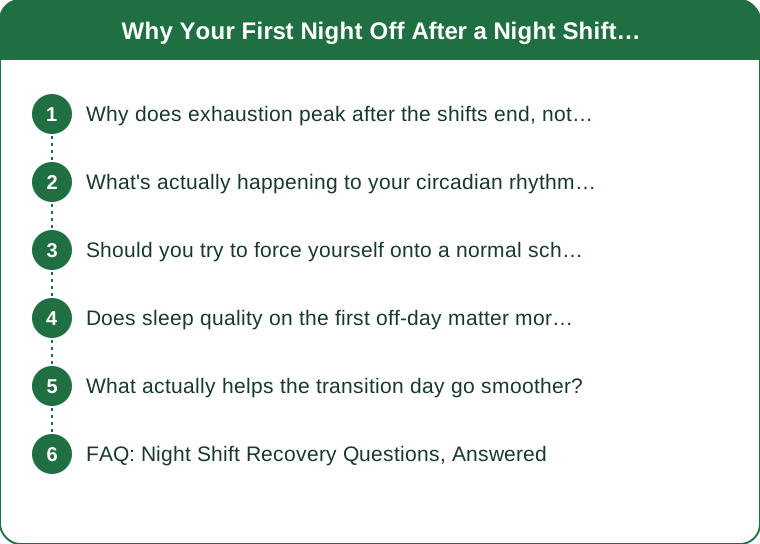
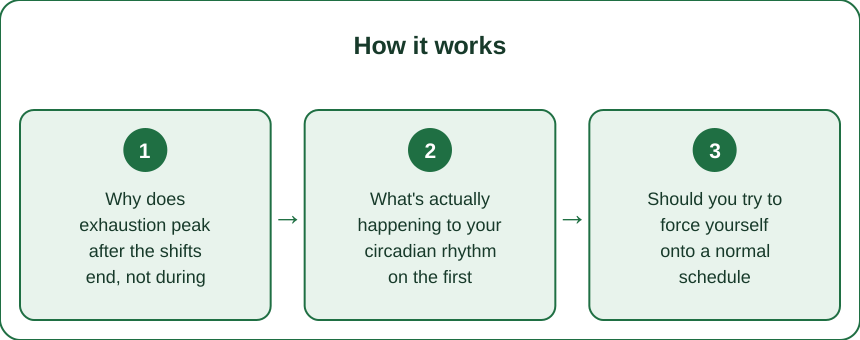
Why does exhaustion peak after the shifts end, not during them?
During active night shifts, routine and mild adrenaline provide structure that keeps your body functioning on a workable, if not ideal, schedule. Once shifts stop, that external structure disappears right as your body attempts to shift its circadian rhythm back, creating a period of genuine physiological confusion.
What’s actually happening to your circadian rhythm on the first night off?
Your body is caught between two schedules — not fully adjusted to nights, and not yet readjusted to a normal day-night pattern — which commonly produces a specific kind of fatigue that feels different from simple tiredness, sometimes described as feeling ‘wired but exhausted.‘
Should you try to force yourself onto a normal schedule immediately?
Not abruptly — a gradual shift over 1-2 days, rather than an immediate hard switch, tends to reduce the disorientation and fatigue of the transition compared to trying to force normal daytime wakefulness right away.

Does sleep quality on the first off-day matter more than sleep quantity?
Yes, often — a shorter but well-timed sleep block (dark room, consistent timing) tends to help the transition more than a very long but poorly timed sleep that further confuses the circadian signal your body is trying to reset.
What actually helps the transition day go smoother?
Light exposure timing matters significantly — getting natural light in the late afternoon or early evening on your first off-day, rather than very early morning, helps nudge your circadian rhythm toward a normal schedule without a jarring full reset.
FAQ: Night Shift Recovery Questions, Answered
How many days does full circadian recovery usually take?
Most people need roughly one day of gradual transition per one to two night shifts worked, though this varies significantly by individual and how many consecutive nights were worked.
Is it normal to feel worse emotionally, not just physically, on the first off-day?
Yes — circadian disruption affects mood regulation as well as physical energy, so irritability or low mood on the first off-day is a common, expected part of the transition.
Should caffeine be avoided entirely on the transition day?
Not entirely, but timing it earlier in the transition day and avoiding it close to your planned normal-schedule bedtime helps avoid further disrupting the reset.
TL;DR:
- The first night off often feels worse because routine and adrenaline disappear right as your circadian rhythm tries to reset
- A gradual 1-2 day transition beats an abrupt schedule switch
- Well-timed sleep matters more than simply longer sleep on the transition day
- Afternoon or early-evening light exposure helps nudge your rhythm back without a jarring reset
Plan your first off-day as a transition day, not a normal day off — that mindset shift alone reduces some of the frustration when it feels harder than expected.
Keep Reading
This article is for general informational purposes only and is not medical advice. Always consult a qualified health professional for guidance specific to you.