How to Actually Sleep After a Night Shift When the Sun Is Coming Up
Quick Answer: Morning light is the strongest signal telling your body to be awake, and the commute home delivers it at the worst possible moment. Wearing dark wraparound sunglasses from the moment you leave work, blacking out the bedroom completely, and keeping a fixed sleep start time do more than any supplement. Most day-sleep problems are light problems.
You are exhausted at 7am and wide awake at 8:30 in a dark room.
The twenty minutes between the hospital door and your front door is usually what happened.

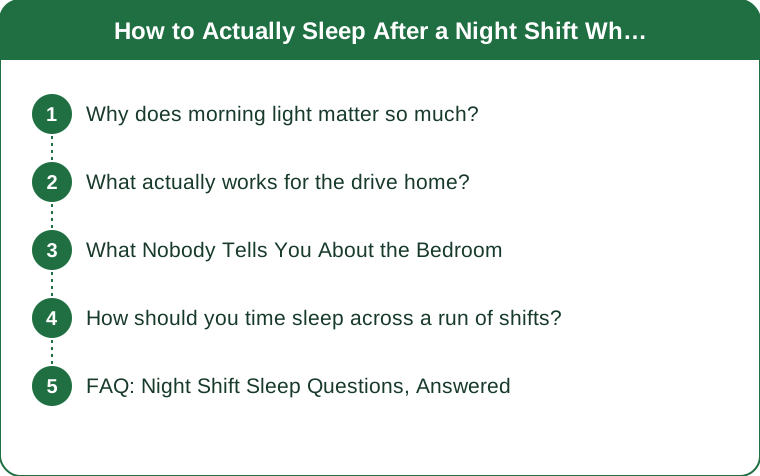
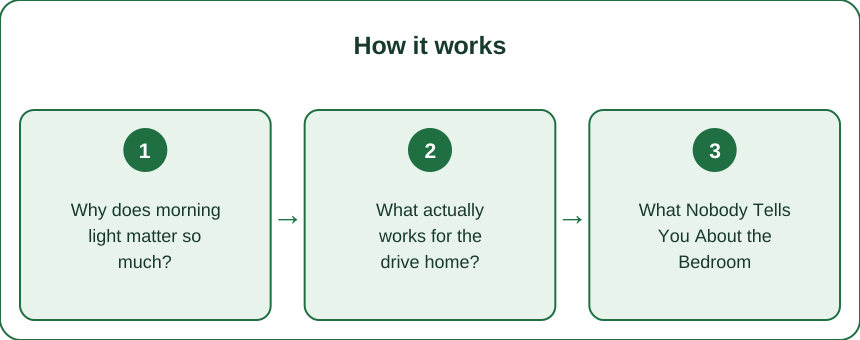
Why does morning light matter so much?
It is the primary input to the clock that controls your sleep.
Light is the dominant circadian signal. Specialized cells in the retina respond to light — especially blue wavelengths — and send that signal directly to the brain’s master clock, which governs when melatonin is released and when body temperature falls.
Morning light is the strongest wake signal there is. Light exposure at that phase advances the clock and suppresses melatonin, which is exactly the opposite of what you need when you are heading to bed.
Outdoor light is vastly brighter than indoor. A cloudy morning still delivers 1,000 to 10,000 lux; a well-lit room is around 300 to 500. The commute is by far your largest light exposure of the day.
It works through the eyes, not the skin, which is why the intervention is glasses rather than clothing.
And the effect is fast. Even 10 to 15 minutes of bright morning light meaningfully suppresses melatonin, which is roughly the length of an average commute.
What actually works for the drive home?
One item, worn consistently.
Dark wraparound sunglasses, on before you leave the building. Wraparound matters because light entering from the sides reaches the retina just as effectively. Standard sunglasses block a substantial amount of the incoming light and much less of the peripheral.
Some shift workers use blue-blocking amber lenses, which target the specific wavelengths the circadian system responds most strongly to. Either approach is better than nothing; the key variable is coverage and consistency.
Keep them on until you are inside with the blinds closed. The walk from the car to the door is short and bright, and it is the step people skip.
Safety first, obviously — if the glasses are too dark to drive safely at dawn, they are the wrong glasses. You want dark, not dangerous.
If you take public transport, add a hood or a cap. Overhead light exposure through a bus window over 30 minutes is substantial, and a brim cuts a meaningful portion of it.

What Nobody Tells You About the Bedroom
Blackout is a binary, not a spectrum, and most bedrooms fail it.
Small light leaks matter more than people expect. A gap at the edge of a blackout curtain puts a bright strip across the room, and the light reaching your eyes through closed lids is still detected. Blackout curtains without side seals often reduce light by far less than the packaging implies.
A sleep mask is more reliable than curtains. It sits against the face and removes the leak problem entirely. A contoured mask that does not press on the eyes is worth the small extra cost, since a mask you push off in your sleep is not doing anything.
Cover the small lights too. Standby LEDs, chargers, and clock displays add up in an otherwise dark room, and they are in your visual field for hours.
Temperature matters nearly as much as light. Core temperature has to fall for sleep to initiate, and daytime rooms are warmer than nighttime ones. A room around 65 to 68°F, or a fan, addresses a problem most day sleepers attribute entirely to light.
And handle noise before it wakes you rather than after. Daytime noise is unpredictable — deliveries, neighbors, traffic. A fan or white noise machine covering the range where those sounds sit is more effective than earplugs alone, which block steady noise well and sudden noise poorly.
How should you time sleep across a run of shifts?
Consistency beats duration, and the schedule you pick matters less than keeping it.
Pick one approach and hold it for the whole run. Either sleep immediately after the shift, or split sleep into a short morning block and an afternoon block before work. Both work; alternating between them does not.
Immediate sleep suits most people because sleep pressure is highest right after the shift. The trade-off is waking early afternoon with a long stretch before work.
Split sleep suits people who wake after four hours anyway. Four hours in the morning, two to three before the shift, is a legitimate strategy rather than a failure.
Anchor sleep on days off. Keeping a common block — for example 8am to noon — on both work days and off days keeps the clock from swinging fully back and forth, which is the most exhausting pattern of all.
Fall note: as sunrise moves later through autumn, a commute that was in full daylight in August is at dawn or before it in November. That genuinely helps, and it is worth adjusting your sleep start time earlier to take advantage of the darker mornings while they last.
This is general information, not medical advice. Persistent insomnia, excessive sleepiness while driving, or symptoms of shift work sleep disorder should be discussed with a healthcare professional — these are treatable and worth raising.
FAQ: Night Shift Sleep Questions, Answered
Does melatonin help day sleepers?
It can, and timing matters more than dose. Low doses taken before the intended sleep period are more useful for shifting the clock than large doses taken to force sleep. Because timing depends on your specific schedule and melatonin interacts with some medications, this is worth discussing with a pharmacist or doctor rather than guessing.
How much sleep should I get between night shifts?
Aim for the same total you need normally, typically seven to nine hours, whether in one block or split. Day sleep tends to be more fragmented and lighter, so budgeting slightly more time in bed than you would at night is realistic rather than indulgent.
Should I stay on a night schedule on my days off?
Fully flipping back and forth is the most disruptive pattern, but complete night schedules on days off cost you your social and family life, which has its own health consequences. The common compromise is anchor sleep — keeping a consistent four-hour core block every day regardless of schedule — which preserves some circadian stability without giving up your days entirely.
TL;DR:
- Morning light on the commute home is the main reason day sleep fails; 10 to 15 minutes is enough to suppress melatonin.
- Dark wraparound sunglasses from the building door to the bedroom, every shift.
- A sleep mask beats blackout curtains, and room temperature matters nearly as much as light.
- Pick one sleep schedule per shift run and keep an anchor block on days off. Buy the wraparound sunglasses first. It is the cheapest item on the list and it addresses the largest single light exposure in your day.
Keep Reading
This article is for general informational purposes only and is not medical advice. Always consult a qualified health professional for guidance specific to you.