How to Actually Protect Your Social Life on a Night Shift Schedule
Quick Answer: Protecting a social life on night shift works best around a few deliberately scheduled, recurring touchpoints — a weekly meal or call on your regular day off — rather than trying to stay spontaneously available to a schedule that doesn’t match anyone else’s, which tends to fail and lead to social withdrawal over time.
Night shift schedules quietly erode social life not through any single missed event, but through the slow accumulation of a schedule that never quite lines up with anyone else’s — protecting it takes deliberate structure, not just good intentions.

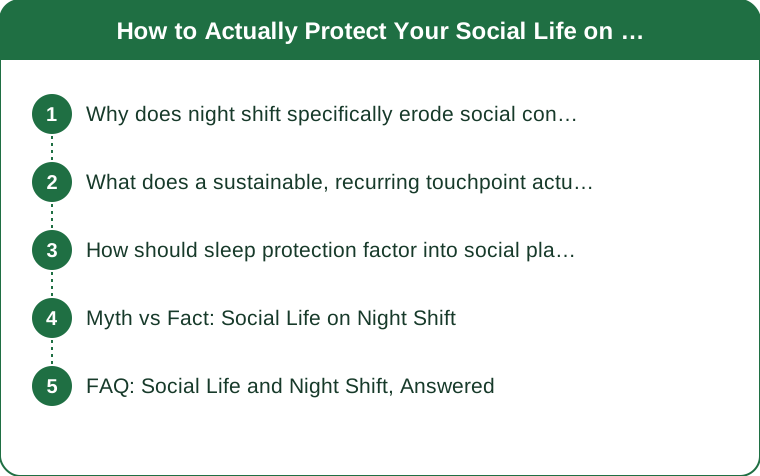
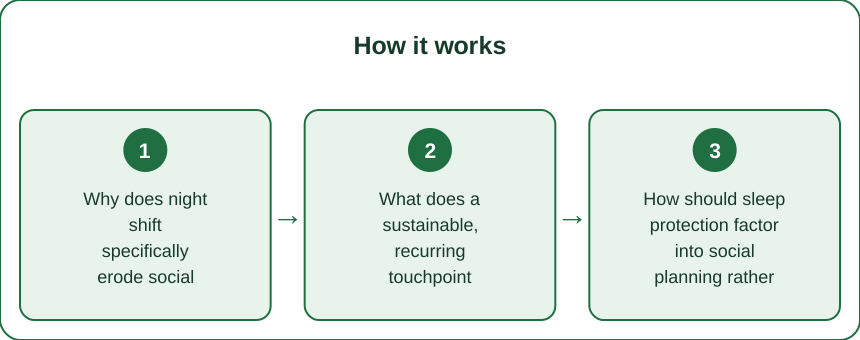
Why does night shift specifically erode social connection more than other nontraditional schedules?
The mismatch isn’t just about being awake at different hours — it’s that most social plans (dinners, weekend gatherings, weekday calls) are built around a daytime schedule by default, so a night shift worker has to actively opt into rearranging their sleep or energy to participate, rather than plans naturally fitting their schedule the way they would for someone on a standard 9-5. Over months, the friction of constantly being the exception adds up, and it’s genuinely easier to decline than to keep renegotiating.
What does a sustainable, recurring touchpoint actually look like?
Rather than trying to stay generally available whenever something comes up, picking one or two specific, recurring commitments on your regular days off — a standing weekly coffee, a same-day-every-week video call with a specific friend or family member — builds something predictable into the schedule that doesn’t require renegotiating every single week. This recurring structure is more sustainable than sporadic, one-off plans that depend on remembering and rearranging sleep each time.

How should sleep protection factor into social planning rather than being sacrificed for it?
A workable approach treats sleep as a fixed block to plan around, not a flexible buffer to sacrifice for social plans — scheduling the recurring touchpoint at a specific time that doesn’t require compressing sleep (often right after waking, before the shift, rather than squeezed into what would otherwise be sleep time) protects both the relationship and the recovery your body needs, rather than trading one for the other repeatedly.
Myth vs Fact: Social Life on Night Shift
Myth: A strong social life and a night shift schedule are fundamentally incompatible. Fact: Recurring, deliberately scheduled touchpoints — rather than spontaneous availability — can sustain real connection even on a schedule that doesn’t match most people’s default hours.
Myth: Sacrificing sleep occasionally for social plans is a reasonable, sustainable tradeoff. Fact: Repeated sleep sacrifice for social plans tends to produce burnout that undermines both work performance and the ability to be present for the relationship — protecting sleep as fixed, and building plans around it, holds up better long-term.
FAQ: Social Life and Night Shift, Answered
How do I explain my schedule to friends who don’t work nontraditional hours?
Being specific and concrete — ‘I’m free Tuesday afternoons before my Wednesday shift’ rather than a vague ‘I work nights, so it’s complicated’ — gives friends something actionable to plan around, rather than an ambiguous constraint that’s easy to stop trying to work with.
Is it worth finding other night shift workers to socialize with specifically?
Yes, often — connecting with others on similar schedules (coworkers, local night-shift community groups) removes the scheduling mismatch entirely and can fill some of the social gap that daytime-scheduled friends can’t easily accommodate.
How many recurring social commitments is reasonable to maintain on a night shift schedule?
One to two consistent, well-protected touchpoints tend to be more sustainable and meaningful than trying to maintain many loosely scheduled ones — quality and consistency of a couple of connections often serves better than spreading thin across more.
TL;DR:
- Most social plans default to a daytime schedule, which is the actual source of the mismatch
- One or two specific, recurring touchpoints on regular days off outlast sporadic, spontaneous plans
- Protect sleep as a fixed block and schedule around it, rather than sacrificing it repeatedly
- Connecting with other night shift workers can fill gaps daytime-scheduled friends can’t
A social life on nights doesn’t have to shrink — it just needs a more deliberate structure than a typical daytime schedule requires.
Keep Reading
This article is for general informational purposes only and is not medical advice. Always consult a qualified health professional for guidance specific to you.