Why Blackout Curtains Are Not Enough for Day Sleep
Quick Answer: Darkness handles one input. Day sleep also has to survive noise, temperature, and - most importantly - a circadian system that is actively signalling wake at 10am regardless of how dark your room is. Core temperature rising through the morning is the biggest unaddressed factor, followed by household and street noise that a curtain cannot touch. The highest-value additions are a cooler room, continuous sound masking, and a fixed sleep window your body can start to predict.
Which is why two shift workers with identical curtains can have completely different results.
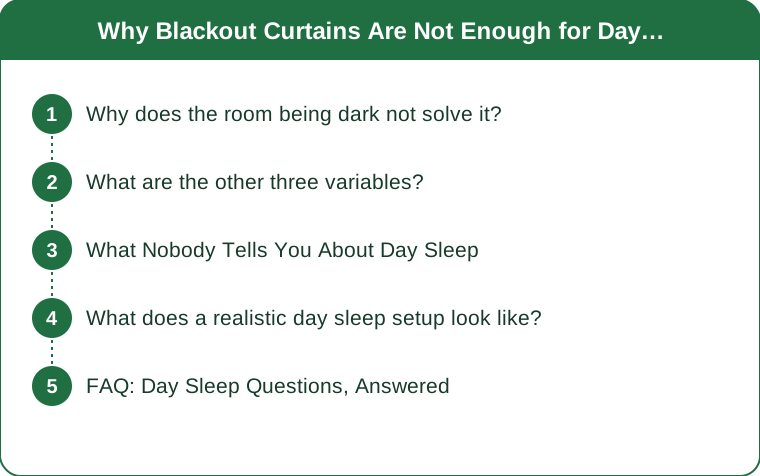
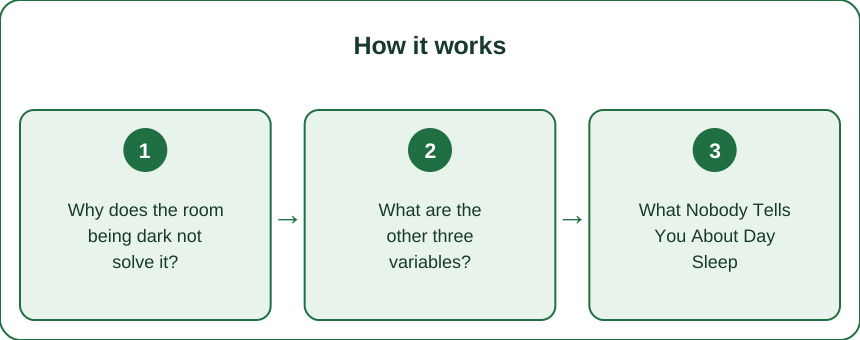
Why does the room being dark not solve it?
Because darkness suppresses one signal and leaves three running.
Your circadian clock is not only light-driven. Light is the strongest input, but core body temperature, cortisol rhythm, and feeding times all carry timing information too. Cortisol peaks in the first hour or two after your normal wake time regardless of the curtains - and if your body still thinks morning is wake time, that peak lands in the middle of your sleep.
Core temperature rises through the morning. Sleep depends on a falling temperature; your body starts raising it from around 4 or 5am and keeps going until late afternoon. You are trying to sleep on the upward slope, which is the physiologically worst part of the day for it.
Daytime noise is structurally different from night noise. It is not just louder - it is more variable, more intermittent, and carries more information. A doorbell wakes you far more effectively than steady traffic, and daytime is made of doorbells.
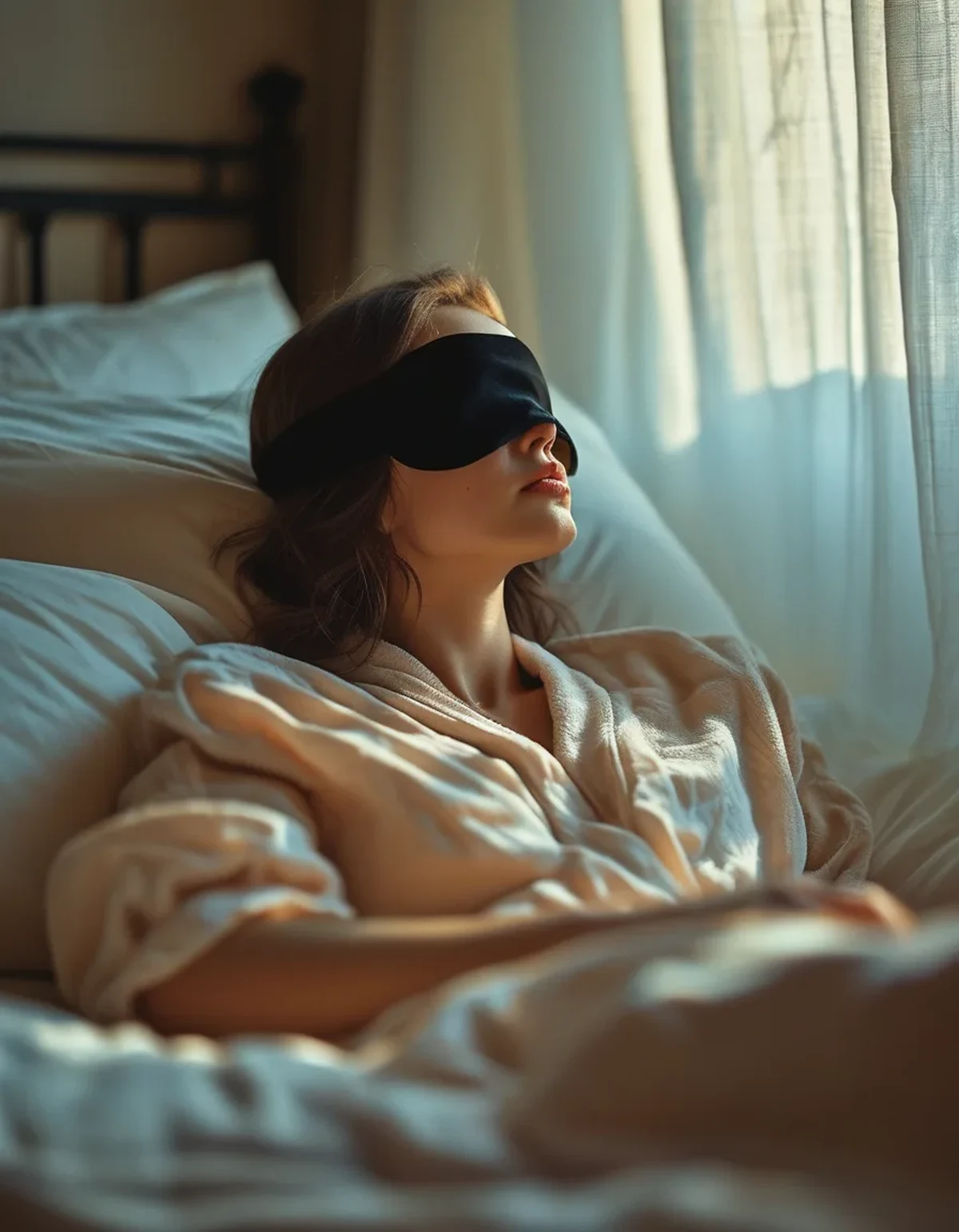
And light leaks matter more than they look. A pencil-thin gap at the curtain edge can deliver a surprisingly strong signal, and light reaching the eyes through closed lids still registers. Blackout curtains fitted inside the recess almost always leak at the sides - a fitted mask handles what the curtain cannot.
What are the other three variables?
In order of how much they usually cost you.
1. Temperature - the most underrated. Bedrooms warm through the day exactly as your core temperature rises, which is a double problem. A room at 21C at 10am and 25C at 2pm will fragment the second half of your sleep almost regardless of anything else. Target somewhere around 17 to 19C, use a fan on low for both cooling and sound, and close the curtains before you leave for your shift so the room does not preheat.
2. Continuous sound masking. The goal is not silence, which is unachievable and also fragile - a single noise against silence is more disruptive than the same noise against a steady background. A fan, a white noise machine, or brown noise through a speaker raises the floor so deliveries, dogs, and hallway conversations do not spike above it. Earplugs work too, and combine well with masking rather than replacing it.
3. Timing consistency. Your circadian system adapts to predictable patterns and struggles with variable ones. Sleeping 9am to 4pm every day is far more effective than sleeping eight hours at a different time each day, even if the total is identical. Anchoring the start matters most.
And a fourth honourable mention: the household. Most day sleep is interrupted by people who forgot, not by strangers. A sign on the door and a shared calendar entry solve more wake-ups than any product.
What Nobody Tells You About Day Sleep
It will never feel like night sleep, and expecting it to is its own problem. Even well-adapted shift workers typically get somewhat less total sleep and less deep sleep during the day. The goal is good day sleep, not equivalence - measuring it against a good night’s sleep guarantees disappointment.
The second half is the fragile half. Most people fall asleep fine after a shift and then fragment from around hour four, as temperature climbs and household noise builds. This is why split sleep - a long block after the shift plus a nap before it - suits many people better than one uninterrupted attempt.
Your commute home is doing damage. Bright morning light on the drive is the strongest possible signal telling your clock it is daytime. Sunglasses on the way home are one of the cheapest, highest-impact interventions available - and they matter most on bright September mornings when the sun is low and directly in your eyes.
Waking to use the bathroom is often thermal, not urinary. People who wake warm attribute it to their bladder. Fix the room temperature and a surprising number of those wake-ups stop.
And the first day off is the worst day, deliberately. Trying to flip fully back to a night schedule on day one costs you more than it gains if you are back on nights in two days. Anchor sleep - keeping a consistent core block even on days off - is the compromise most people land on.
What does a realistic day sleep setup look like?
Working through it in the order you would actually do it.
Before the shift: close curtains and drop the heating so the room does not warm through the day. Set the fan or noise machine to run, so you are walking into an already-prepared room rather than assembling one while exhausted.
On the way home: sunglasses, and ideally not the brightest route. This is protecting the signal, not comfort. If you shop after a shift, do it before the sun is high or on a different day.
Arriving home: dim lights, no bright screens, and a short wind-down - the fake commute. Fifteen minutes of low-stimulation routine tells your body the shift ended, which matters because your nervous system does not switch off at the car door.
Sleep setup: mask plus curtains, earplugs plus masking sound, cool room, and a phone that is genuinely on do not disturb. Redundancy is the principle - each layer covers the other’s gaps.
Waking: bright light immediately on purpose, ideally within a few minutes. This anchors the other end of the rhythm and is as important as the darkness at the start.
Caffeine: cut off roughly six to eight hours before your intended sleep, which for a night shift usually means nothing after around 2 or 3am. This is the adjustment people resist most and benefit from most.
This is general information, not medical advice. Persistent day sleep problems - particularly with daytime sleepiness at work - are worth raising with a doctor, since shift work sleep disorder is a recognised and treatable condition.
FAQ: Day Sleep Questions, Answered
How dark does the room actually need to be?
Dark enough that you cannot see your hand in front of your face after ten minutes of adjustment. Most blackout curtains do not achieve that alone because of edge leakage - a fitted mask closes the gap cheaply.
Is a sleep mask better than blackout curtains?
They solve different parts. Curtains reduce room warming and general light; a mask handles the leaks and travels with you. Using both is genuinely better than either alone.
What temperature should the room be?
Around 17 to 19C for most people. The key is that it does not rise through your sleep, which usually means closing curtains early and using a fan rather than relying on the morning being cool.
Why do I always wake at the same time mid-sleep?
Most often a temperature or noise pattern that repeats daily - the heating coming on, the school run, a delivery window. Track it for three days and the cause usually becomes obvious.
Is split sleep worse than one block?
Not necessarily. Many shift workers do better with a long block after the shift and a shorter nap before it. Total sleep matters more than whether it came in one piece.
Should I use melatonin?
It is used for shift work sleep timing, but dose and timing matter a lot and it interacts with other conditions and medications. That is a conversation with a pharmacist or doctor, not a purchase decision.
TL;DR:
- Darkness handles one input. Circadian timing, temperature, and noise are the other three - and temperature is the most commonly ignored.
- Your body is raising core temperature from around 5am onward, so you are sleeping on the wrong slope.
- Use continuous sound masking rather than chasing silence, and combine earplugs with it.
- Sunglasses on the commute home are among the highest-impact, cheapest fixes available.
- Keep the start time consistent, prepare the room before your shift, and expect the second half of sleep to be the fragile half.
Good day sleep is a layered system, not a single purchase. The curtains were a reasonable first move - they were just never going to be the whole answer.
This is general information, not medical advice.
Keep Reading
This article is for general informational purposes only and is not medical advice. Always consult a qualified health professional for guidance specific to you.