Why Your Caffeine Cutoff Needs to Move to a Completely Different Time on Night Shift
Quick Answer: The standard daytime caffeine cutoff advice (roughly 6-8 hours before your intended bedtime) still applies on night shift — the number of hours doesn’t change, but the clock time it lands on shifts entirely, meaning a night shift worker sleeping at 9am needs their last caffeine by roughly 1-3am, not by any daytime-associated clock time like 2pm that the original rule was built around.
‘No caffeine after 2pm’ is genuinely useless advice for someone sleeping during the day after a night shift. The underlying principle (caffeine 6-8 hours before bed) is still valid — it just needs to be recalculated against a completely different bedtime.

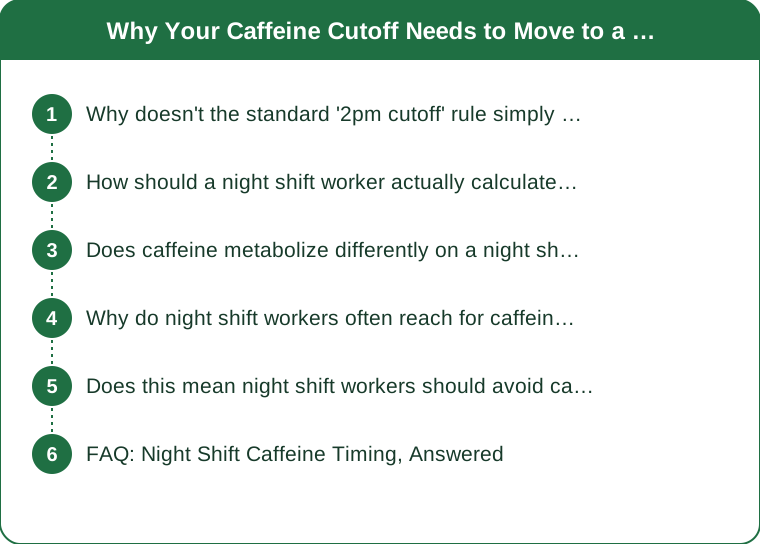
Why doesn’t the standard ‘2pm cutoff’ rule simply not apply to night shift workers?
That specific clock time was calculated for a typical daytime schedule with an evening bedtime around 10-11pm. A night shift worker’s actual bedtime might be 9am, which means anchoring to ‘2pm’ as a fixed rule makes no sense at all — the underlying 6-8 hour buffer principle needs to be recalculated against the worker’s own actual sleep time, not borrowed as a fixed clock time from a different schedule entirely.
How should a night shift worker actually calculate their own cutoff?
Count backward 6-8 hours from your actual planned sleep time — if sleep is planned for 9am, the cutoff lands around 1-3am, meaning caffeine taken to power through the last stretch of a shift ending at 7am could still meaningfully interfere with falling asleep on schedule afterward.
Does caffeine metabolize differently on a night shift schedule versus a normal daytime one?
The metabolic half-life of caffeine (roughly 5-6 hours for most people) doesn’t change based on time of day, but circadian misalignment from night shift work can independently make falling asleep harder regardless of caffeine, meaning caffeine timing errors compound an already more fragile sleep window rather than existing in isolation.

Why do night shift workers often reach for caffeine right when it’s most likely to backfire?
The final hours of a night shift, often the most fatiguing stretch, are exactly when many workers reach for a coffee to push through — which, per the math above, frequently falls inside the 6-8 hour pre-sleep window and directly undermines the sleep that shift is building toward.
Does this mean night shift workers should avoid caffeine during the whole second half of their shift?
Broadly yes, if sleep quality afterward is a priority — front-loading caffeine intake toward the earlier part of a night shift, and relying on other alertness strategies (bright light exposure, brief movement breaks) later in the shift, better protects the sleep window than caffeine timed close to shift’s end.
FAQ: Night Shift Caffeine Timing, Answered
What are effective non-caffeine alertness strategies for late in a night shift?
Bright light exposure, brief physical movement breaks, and staying hydrated all support alertness late in a shift without the sleep-disrupting tradeoff caffeine carries that close to bedtime.
Does the 6-8 hour cutoff window need to be longer for people especially sensitive to caffeine?
Yes — people who metabolize caffeine more slowly (a genetic factor) may need a wider buffer, sometimes 8-10 hours, to avoid sleep interference.
Is decaf a reasonable alternative during the second half of a night shift?
Yes, for the ritual and small residual caffeine content, decaf can satisfy the habitual craving with minimal impact on the sleep window compared to a full-caffeine choice at the same time.
TL;DR:
- The 6-8 hour pre-sleep caffeine buffer still applies on night shift — only the clock time it lands on changes
- Calculate the cutoff backward from your actual planned sleep time, not any daytime-associated clock time
- The most fatiguing final stretch of a night shift is often exactly when caffeine most undermines the sleep to follow
- Front-loading caffeine earlier in the shift and using non-caffeine alertness strategies later protects the sleep window better
Calculate your own cutoff by counting back 6-8 hours from your actual bedtime — not from any daytime rule that was never built for a night shift schedule.
Keep Reading
This article is for general informational purposes only and is not medical advice. Always consult a qualified health professional for guidance specific to you.