Why Your Workouts Feel Impossible on the Second Night Shift in a Row
Quick Answer: Sleep debt compounds across consecutive night shifts, so a workout that felt manageable after shift one can feel dramatically harder after shift two — even though the workout itself hasn’t changed.
The first night shift, you still managed a decent workout before or after. By the second one in a row, the same routine suddenly feels like wading through wet cement. Nothing about the exercise changed. Your recovery reserve did.

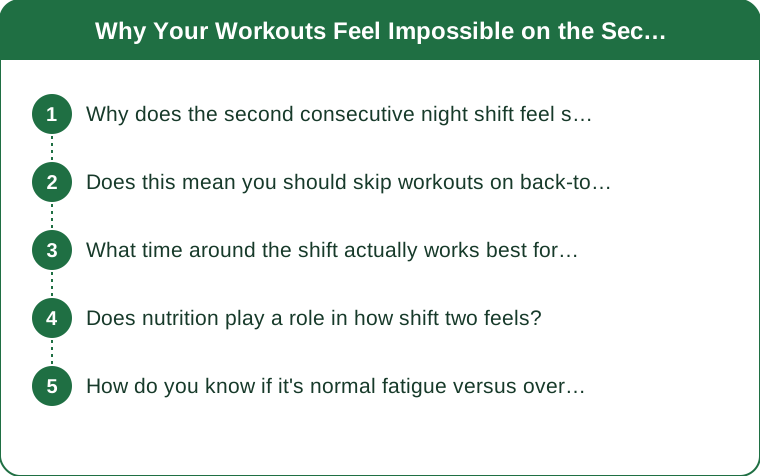
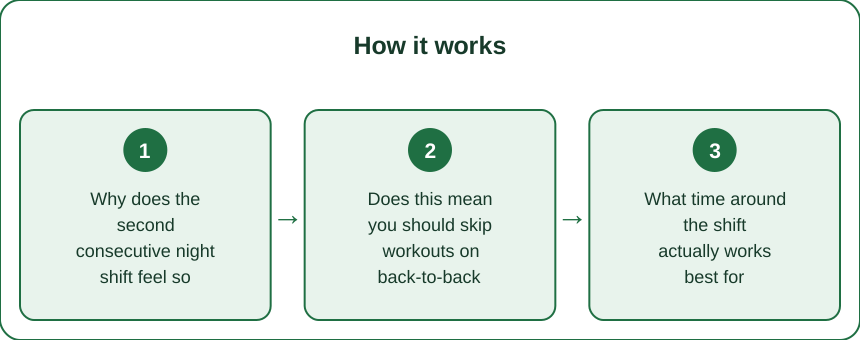
Why does the second consecutive night shift feel so much worse?
Daytime sleep after a night shift is almost never as restorative as normal nighttime sleep — lighter, more fragmented, often shorter. That deficit doesn’t reset in one day; it stacks, so by shift two you’re running on compounded sleep debt, not just “tired.”
Does this mean you should skip workouts on back-to-back shifts?
Not necessarily skip — scale. A lower-intensity session (walking, light mobility work, an easy bike ride) maintains the habit without asking a sleep-debt-depleted body for a personal record. Pushing hard intensity on shift two is when injury risk and burnout both climb.

What time around the shift actually works best for exercise?
Right before the shift starts tends to work better than right after it ends on back-to-back nights — post-shift, your body is already gearing toward sleep, and adding a hard workout there delays recovery further.
Pre-shift movement, even light, can also help with alertness for the first few hours of work.
Does nutrition play a role in how shift two feels?
Yes — under-fueling during the first shift compounds with sleep debt to make the second shift’s workout feel worse than either factor alone would. A proper meal before the second shift starts (not just coffee) noticeably changes how a workout that night feels.
How do you know if it’s normal fatigue versus overtraining?
Normal shift fatigue improves with a full sleep cycle on your next day off. If heavy fatigue persists even after a proper recovery day, that’s a signal to scale back workout intensity across the whole rotation, not just the back-to-back nights.
TL;DR:
- Daytime sleep after a night shift is lower quality, and the deficit compounds
- Scale intensity down on shift two instead of skipping the workout entirely
- Pre-shift movement works better than post-shift on back-to-back nights
- Persistent fatigue past a full recovery day signals it’s time to scale the whole week back
The second night shift isn’t a willpower test — it’s a sleep-debt math problem. Scale the workout to match the debt, and the habit survives the rotation instead of getting abandoned by week two.
Keep Reading
This article is for general informational purposes only and is not medical advice. Always consult a qualified health professional for guidance specific to you.